User signs in with a .gao identity
A lifetime, user-owned identifier replaces the platform account. The same identity is used for messaging, payments, business profiles, and agent binding — no per-app signup.
Flagship
Gao Social is the flagship application of Gao Internet. It is the single surface that exercises every layer of the stack — identity, gateway, SDK, settlement, transport, infrastructure, and AI execution — in a coherent product for people and local businesses.
Flagship application
Not a Web3 social app. Not a chat client. Gao Social is an action network where every interaction can become a transaction, a relationship, or an agent task — built on lifetime .gao identity, non-custodial settlement, capability-gated AI execution, and end-to-end encrypted messaging. It is the flagship surface that exercises every layer of Gao Internet in a single product.
The journey
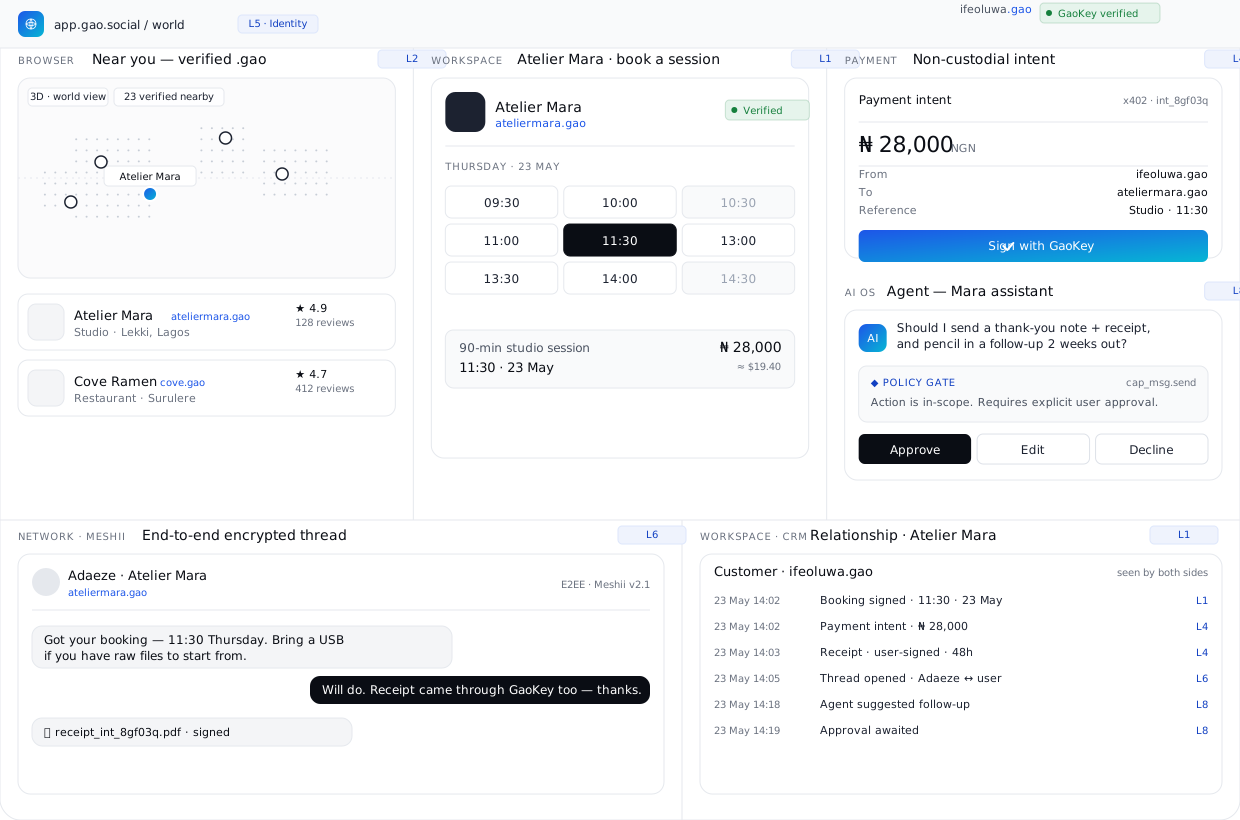
A single Gao Social journey — sign-in, discover a local business, message, book, pay, follow up — touches every layer of Gao Internet. The user owns the identity. The user signs the payment. The agent acts under scoped permission. The platform doesn't custody any of it.
A lifetime, user-owned identifier replaces the platform account. The same identity is used for messaging, payments, business profiles, and agent binding — no per-app signup.
The gateway displays trust state, surfaces verified .gao endpoints, and prepares the user for payment and AI prompts inline.
Social posts, 3D map exploration, local business pages, and booking flows live in one operating console — not split across five apps.
Users and businesses exchange messages, receipts, and booking confirmations on a transport-agnostic, end-to-end encrypted protocol.
Booking a service or buying a product produces a user-signed payment intent, a verifiable receipt, and a refund path — without the platform holding funds.
The business sees the new customer, the receipt, and the conversation in Gao CRM. The user sees the same record on their side, owned by them.
Under a scoped capability token — and only that token — an agent can draft a follow-up message, suggest a reschedule, or propose a payment. Sensitive actions still require user approval.
Travel, fitness, commerce, and AI builders integrate via Gao SDK — using the same identity, payments, and messaging primitives, without becoming custodians.
Why this matters
A network of unrelated dApps does not prove a stack works. A single application that uses identity, payments, messaging, workspace, CRM, and AI execution — under one user authorization surface — does. Gao Social is that proof: it ships against the same primitives that third-party developers build on through Gao SDK.